Peccioli — The Tuscan Village That Chose Art
Peccioli is the closest village to Agriturismo Il Gattero, literally just beyond the next hill, around a 15-minute drive away. It has cobbled streets, sweeping valley views, and a history dating back to the Etruscans. Perfect for a slow morning filled with coffee, wandering, and contemporary art.
But what truly sets Peccioli apart from dozens of similar Tuscan villages is a decision made in the 1990s, one that changed the future of the town completely.
Mayor Renzo Macelloni decided that Peccioli would become a place where art, architecture, and everyday life could meet. He invited artists from around the world to create works not for galleries, but directly for the people living there, and for anyone passing through.
The result? Today, Peccioli is often described as “Italy’s little capital of contemporary art.” And in 2024, the village won Borgo dei Borghi, the annual Rai 3 competition in which twenty villages from across Italy compete for the title of the country’s most beautiful village.
What to Look for on the Streets and Walls?
Exploring Peccioli feels a little like a treasure hunt. Works of art appear in the most unexpected places. Here are a few worth searching for:
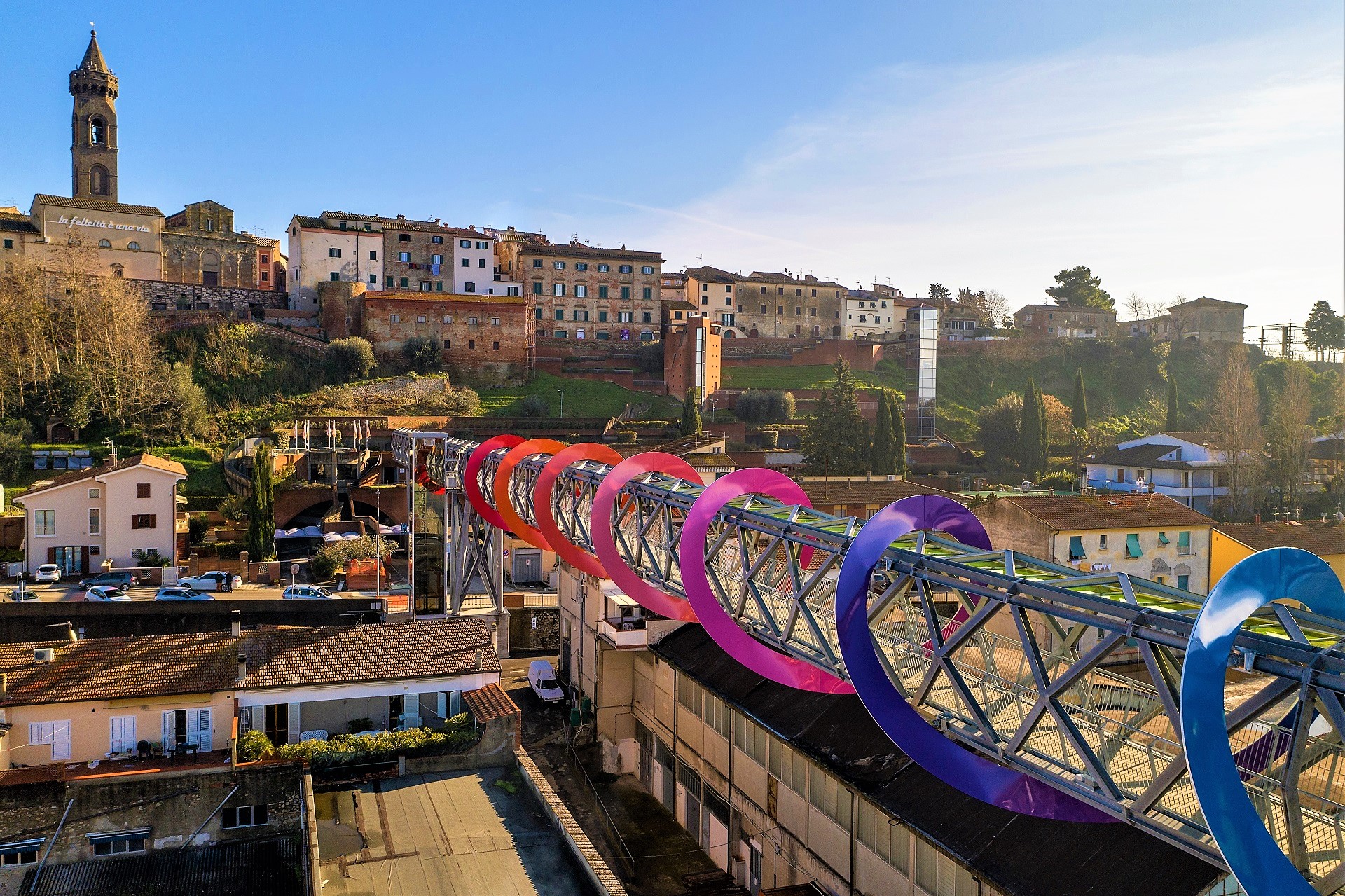
Endless Sunset — Patrick Tuttofuoco
A colourful promenade wrapped in a twisting ribbon-like structure that leads your eye straight towards the valley views. One of the most photographed spots in Peccioli.
Lo sguardo di Peccioli — Vittorio Corsini
A wall covered with photographs of eyes staring back at you from every direction. Slightly unsettling, impossible to forget.
Bastone — Federico De Leonardis
A walking stick carved directly into the brick walls along Via Bastioni. You could easily miss it unless you know it’s there, which is exactly the point.
Chit-Chatting — Vittorio Corsini
Six fig trees in pots arranged in two rows facing one another in the courtyard of Palazzo Pretorio. A silent “conversation” carried out by plants.
Coppa Sabatini Mural
On Via Cavour, you’ll find a mural by Frederico Draw and Rodrigo Contra, created for the 70th edition of the Coppa Sabatini cycling race, an annual race that passes directly through Peccioli.
Together, all these works form the official MACCA trail — the Open-Air Museum of Contemporary Art featuring more than 70 installations throughout the village. Each piece is marked with a plaque in both Italian and English.
Terrazza Panoramica — Absolutely Worth the Climb
This is one of those views you don’t forget easily. Terrazza Panoramica is a 600-metre panoramic terrace with a dramatic cantilevered structure suspended 20 metres above the ground, overlooking the rolling hills of Upper Valdera. It was designed by Mario Cucinella as part of the Palazzo Senza Tempo complex, and it’s one of those rare places where the architecture itself feels like a work of art. Inside the palace, you’ll also find a café and gallery spaces hosting contemporary art exhibitions. Access to the terrace is completely free.
Ghizzano — Just 15 Minutes from Peccioli, and Well Worth a Visit
If you have a little extra time, it’s worth driving over to the neighbouring village of Ghizzano. British artist David Tremlett convinced the residents of Via di Mezzo to paint the façades of their houses in shades of green and brown, colours inspired directly by the surrounding Tuscan hills. The result feels as though the landscape itself has flowed onto the walls of the village. You’ll also find a marble sphere in front of the church, created by Alicja Kwade, whose works can also be seen on the rooftop terrace of the Metropolitan Museum of Art in New York.
Parking — Important Before You Drive In
Peccioli has a ZTL (Zona a Traffico Limitato) — a restricted traffic zone covering the historic centre. Entry is monitored by cameras and allowed only for authorised vehicles. If you drive in without permission, the fine will eventually arrive by post. Not worth the risk.
Where to Park: 📍Parcheggio Multipiano (recommended) Viale Mazzini 41
A multi-storey car park located right next to the entrance to the old town. From there, a modern covered walkway with lifts takes you directly into the historic centre — and is honestly a small architectural attraction in itself.