Volterra — A Town Suspended in Time
Volterra is a very small town — home to just around 10,000 people. The streets are compact, everything is within walking distance, and although there’s plenty to see, two relaxed hours are more than enough to experience the highlights, eat something delicious, and leave feeling like you truly saw the place properly. There’s no need to rush here.
Agriturismo Il Gattero → Volterra: approximately 35 minutes by car
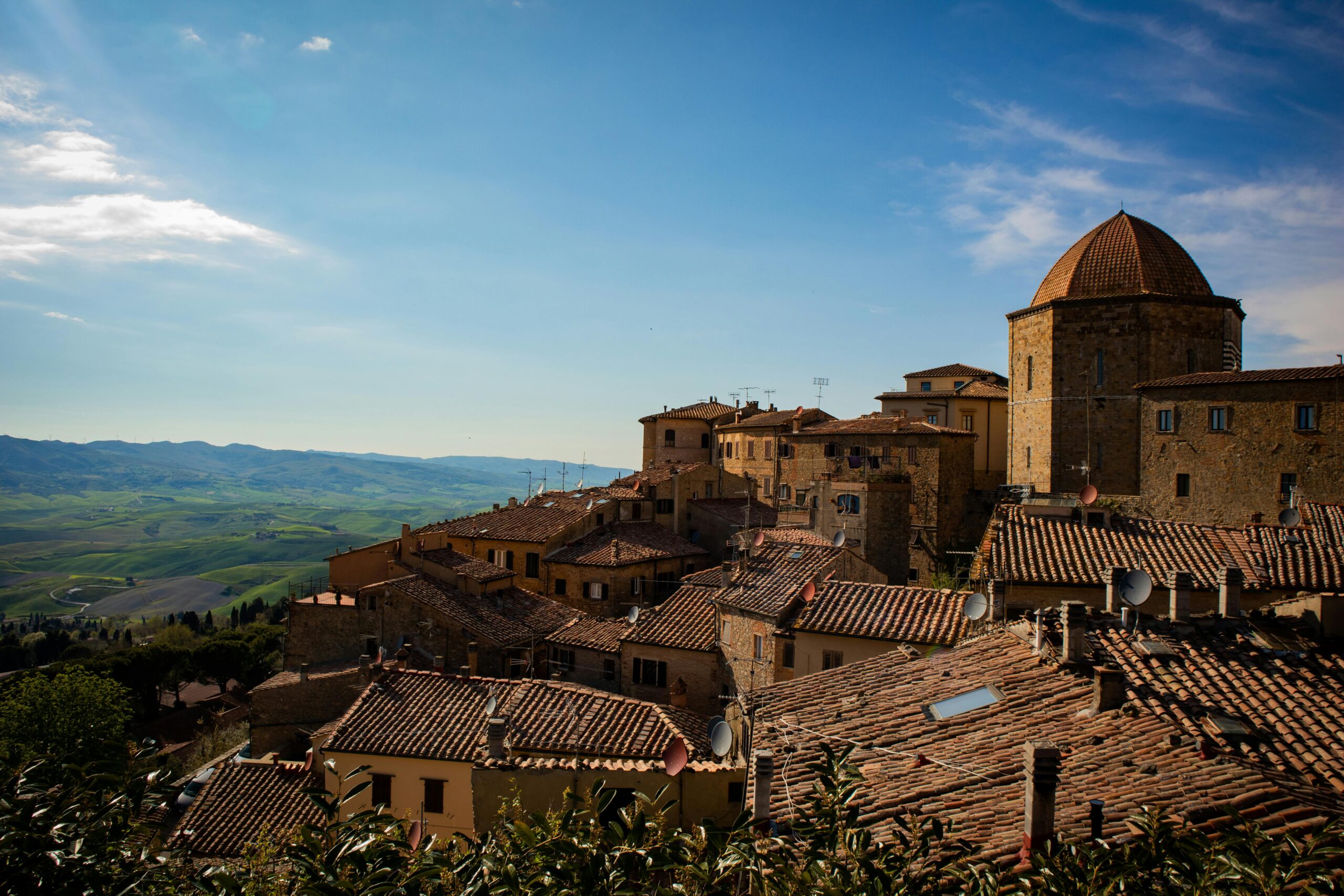
Volterra sits on a high plateau around 550 metres above sea level, surrounded by deeply eroded clay hills known as the balze. It’s one of the best-preserved medieval hill towns in Tuscany, and at the same time one of the most important cities of the Etruscan civilisation. The streets are narrow, the stones ancient, and the views from the city walls almost ruthless in their beauty.
Compared to nearby San Gimignano or Siena, Volterra feels less touristy and far more authentic. Come here with an open mind and comfortable shoes.
Fascinating Details That Change the Way You See the City
A Town Slowly Being Swallowed by the Earth
The balze are a rare geological phenomenon that creates an almost lunar landscape around Volterra. These enormous collapses in the fragile clay hills have, over centuries, swallowed walls, churches, and entire buildings. Volterra was once much larger than it is today — parts of the historic city quite literally disappeared into the abyss. The view of the balze from the western side of the city walls is one of the most surreal landscapes in all of Tuscany.
A Medici Fortress That Is Still a Prison
Fortezza Medicea, towering above the skyline of Volterra, was built in 1474 shortly after Florence conquered the city. To this day, it still functions as a high-security prison. Part of the fortress occasionally opens for guided visits, and inmates even help run special dining experiences for guests. Yes, you can actually have dinner inside a working prison. Volterra is simply that kind of place.
The Gate Nobody Fully Understands
Porta all'Arco is the main surviving monument of Etruscan Volterra, an ancient stone gateway decorated with three mysterious heads. To this day, nobody knows exactly what those faces represent. The gate has stood there since the 4th or 3rd century BC, and you’ll walk through it on your way into the historic centre.
The Statue That Was 2,000 Years Ahead of Its Time
Inside the Guarnacci Etruscan Museum, you’ll find Ombra della Sera - The Evening Shadow. It’s a slender bronze figure of astonishing modernity. With its elongated proportions, despite being created in the 3rd or 2nd century BC, it looks strikingly similar to modern sculpture from the early 20th century. When Ernst Ludwig Kirchner first saw a photograph of it, he reportedly believed someone had copied his artistic style. Nobody had copied him. The Etruscans had simply anticipated expressionism by two thousand years.
What to See
Piazza dei Priori
The heart of Volterra. Palazzo dei Priori is the oldest town hall in Tuscany and dominates the entire square. It’s worth climbing the tower for the views alone, they’re spectacular. Just one warning: the bell is very loud. On the opposite side of the square, inside Palazzo Pretorio, look for the Torre del Porcellino - the “Piglet Tower.” If you look carefully towards the top, you’ll spot a tiny stone figure of a wild boar.
Porta all'Arco
The famous Etruscan gate with the mysterious stone heads mentioned earlier. Enter the city from the southern side if you can, it feels like the proper way to arrive in Volterra.
Guarnacci Etruscan Museum
One of the oldest public museums in Europe, founded in 1761, with a collection of more than 600 Etruscan funerary urns. Entry costs around €10. Alongside Ombra della Sera, make sure to find the Urna degli Sposi, a moving terracotta urn showing an elderly married couple lying together, with love carved into stone more than two thousand years ago.
Roman Theatre of Volterra
Considered one of the best-preserved Roman theatres in Italy, located just outside the city walls.You can admire it for free from the panoramic terrace above.
The Balze
Head towards the western edge of the city to see the famous clay cliffs and landslides that shaped Volterra’s landscape. Especially beautiful at sunset, when the rocks begin glowing in warm golden colours. Also highly recommended if you enjoy photography.
Alabaster — Why Is Every Shop Selling the Same White Stone?
As you wander through Volterra, you’ll quickly notice that almost every second shop seems to sell objects made from the same pale, semi-translucent stone. That stone is alabaster, and it has been Volterra’s signature craft for more than two thousand years.
Volterra is the only major centre in Italy where alabaster is still worked using traditional techniques. The tools and methods used by today’s craftsmen are remarkably similar to those used by Etruscan artisans in the 3rd century BC. Step inside one of the workshops, many are open to visitors, and you’ll hear the rhythmic tapping of chisels and see artists covered in fine white dust, transforming blocks of stone into lamps, bowls, sculptures, jewellery, and tiny decorative objects. It isn’t a performance for tourists. This is simply how people still work here.
Shopping Tip Make sure you’re buying genuine alabaster from Volterra, not a cheaper imported imitation. A good piece should feel cool to the touch, and if you hold it up to the light, it should glow softly from within. And honestly, ask the artist directly where the stone comes from.
Volterra Card — is it worth it?
The card includes seven attractions: Palazzo dei Priori, the Roman Theatre, the Guarnacci Etruscan Museum, the Pinacoteca, the Alabaster Ecomuseum, the Etruscan Acropolis and the Museum of Religious Art. It is valid for 72 hours and can be purchased at any of the participating locations. It costs €15 and if you plan to visit more than two museums, it is definitely worth it.
Where to Eat
Volterra isn’t overly touristy, and the food reflects that. The restaurants around the main square are perfectly solid, but it’s worth wandering into the side streets.
📍Pizzeria Da Nanni — The old man has been making pizza his way for years and has absolutely no intention of changing it. Best ordered takeaway and eaten somewhere along the city walls with a view. If you don’t know what to order, go for a classic. You won’t regret it.
📍La Sosta del Priore — ideal if you want a sandwich in hand and to keep exploring. Fast, good, no unnecessary fuss.
📍Dolceria del Corso — a classic, authentic little café. Coffee and something sweet halfway through your walk. Exactly how a Tuscan sightseeing break should feel.
📍La Vecchia Lira — a recommended restaurant if you’d rather sit down for a relaxed lunch. Proper Tuscan cooking, done well.
📍Life Bistrot — a plant-based restaurant that’s surprisingly good by Tuscan standards. If you prefer something more vegetable-focused, you won’t be disappointed.
And honestly, it’s also worth simply walking into the first place that feels right to you. Volterra rarely disappoints when it comes to food.
Parking
Volterra has a ZTL zone. Driving into the historic centre without permission is prohibited. Park outside the walls and continue on foot.
📍Parcheggio sotterraneo La Dogana — an underground car park right in the heart of the centre, closest to the main attractions. If you want to minimise walking with a stroller, this is the best option.
📍Porta Fiorentina / 📍Parcheggio Via di Porta Diana — located by the historic northern gate. A convenient entrance into the old town and a good starting point for exploring.
📍Parcheggio Viale Ferrucci — on the eastern side of the walls, with beautiful views over the surrounding countryside even before you start walking. From there, it’s just a few minutes on foot along the walls into the centre.
Volterra is a hill town. Expect uphill climbs and downhill walks. Comfortable shoes are an absolute minimum.